Start, Crash, Learn, Repeat: What Failing Feels Like
What failure feels like — raw, frustrating, and transformational. A real story of crashing, reflecting, and rising again.


After working intensively for several days on a "killer" piece of content I developed for my business, I posted it on social media. Expecting a few dozen likes and maybe some hot comments, I only got 3 likes.
Next, I jumped into an emotional rollercoaster. Not for the first time though, but this time the stages of the process were much clearer to me.
I had read about failing before (and we're not sugarcoating it in this article — failing is failing and that's fine), but from reading about it to experiencing it and being able to continue trying and trying week after week, that's a total different story.
That's what this post is about. The different stages I went through on that Thursday and my personal reflection about it.
The Week Where Things Happened
Stage 1: The Dreamer (Monday Morning) — "I Want To Do This"
"I will finally work on my Personal Brand", heard me saying to myself on a Monday morning that seemed to be fully charged with motivation.
There are systems to support me and my new businesses, a steady cashflow, and a protected and always nurtured momentum. I spent months building them.
2025 had been quite a year for me thus far. 2 major things happened: 1. I exited a business that I built from the ground up and spent years working on, and 2. I experienced the most unimaginable uncertainty going through my visa process in Canada. So after temporarily moving back to Argentina, I figured that I had to reconnect to myself and find something new.
The first months of the year past along with strong mental noise that slowly decreased as my relationship with myself improved. And once I was "done" (one is never "done" in reconnecting to self), I decided to start working again.
So here I am. 36 years old, few companies built, lots of victories and defeats, a bag full of systems and processes adapted from books or advice, some developed by me or my teams, some capital, and the inner drive that I needed to start this new chapter.
Few weeks back, I had set up a killer set of OKRs and the surrounding tools that my team and I needed to crush them. Everyone was ready and knew what to do.
Except that this time I was going to be super exposed and wasn't really sure if this was gonna work. "What if no one really cares about my content?", I said. But my inner Dreamer answered: "You know what, I'll do it anyway. These things work. I used them myself and refined them over the years. I have built multiple businesses using this stuff. If this works for me, it could work for someone else."
And I agreed.
Stage 2: Building Stuff (Tuesday and Wednesday) — "Let's Build This"
I grabbed the beautiful Dingbats notebook I've been carrying on for the last few years with lots of ideas, sketches, notes from books I read, experiences, etc, and from everything that I could have possibly shared, I decided to start with my "Goals-to-Done framework".
This is a combination of OKRs, minimalism, productivity techniques, and time management stuff. If you're a goal setting kind of person, you know that from setting the goals to deciding what to work on at Tuesday 11 am there's a big distance. And since my teams and I had experienced this many times, I had put together processes and frameworks so that everything works within a system. (If you're interested, here's a PDF summary you can download).
As I was compiling my notes and putting things together I felt proud. I was looking at a crazy amount of small details with huge background, not just trivial decisions. The doc I was building reminded me of quotes from books I had read or advice I'd received that led me to incorporate subtle but important details to this framework. This was not random stuff put together with some ChatGPT. This was real.
Organizing everything in few pages was a challenge. Making it look nice was even worse. I get by with Figma and general design, but nothing compared to what a real designer can do. However, The Lean Startup methodology has been flowing through my veins since I first read about it, and the Adventurer inside me remembered me: "If you're not ashamed of your MVP you launched too late".
And so again, I agreed.
Stage 3: Thursday — "Get It Out There"
At this point, the Adventurer had taken the wheel.
We all have different personalities within. Alain Cardon, the person I learned Systemic Coaching from, said once (although I can't remember where or when, nor the exact words):
"every action is preceded by a dance between parts of the self: the dreamer, the doer, the judge, the child, the protector, etc."
Reflecting on that Thursday morning, it's now clearer to me the emotions that were going through my body and guiding my actions: the same I felt when I first skydived — excitement and vertigo.
After reading books such as Million Dollar Weekend and Alex Hormozi's collection, I knew that building stuff don't really matter if you don't put it out there and try your best to sell it. And even though I wasn't trying to "sell" this for a price, social media reactions and comments have a monetary value in today's world. So theoretically, this wasn't that different after all.
I wanted to make everything easy to consume, so I added a 7-slide carrousel and finally scheduled the post on LinkedIn for what ChatGPT said was the best time for my audience: 12 pm ART / 8 am PST.
Stage 4: The Crash — "Oh Sh*t"
At the time of writing this, I'm not an influencer or anything close, so my posts usually get 10-20 reactions plus a few comments from very nice friends. A couple of my posts reached 50+ reactions.
I was expecting this one to easily get 30. And I thought I was being conservative.
As my post went live, I was on a meeting with my friend Richard (who's my go-to person for objective and deeply analytical feedback). I shared the news in all excitement. He had supported me through my worst months and knew what I was now trying to build. He shared my excitement was well.
My world started to shake when he found a ridiculous typo in the first slide of my post. I was like... "shit". And quickly said outloud, in an attempt to comfort myself: "you know what, I like to work fast, like Prince".
We continued to review the rest of my content and my mood just kept declining when I realized that Richard's feedback was spot on as usual, and that my content wasn't really ready to be published. Plus, during that first hour (where posts usually get most of the engagement), I only got 2 likes. And again, from very nice and supportive friends (thanks Ram and Matt! ❤️).
The Adventurer had crashed. And he was severily wounded.
My body felt the disappointment. I wanted to hide from the world or travel back in time to the safety of not trying. I grabbed my head trying to cover my embarrassment.
It really sucked.
Stage 5: Super Saiyan — "Why The F*ck?"
Have you seen a Formula 1 driver crash? Most of the times, they get out of the car and throw their helmets away, kick the car in all rage, and curse everyone and everything. They yell. Loud.

Honestly guys, I felt so frustrated... Like a F1 driver against his car, I lashed out — only this time, the car was me. Nothing seemed to calm me down. Not even my own attempts to relax.
I had these feelings before, although they had grown slow over time (you can read about it here and here), so I knew that I had to channel these energies into something more constructive.
An interesting thing about this "Start, Crash, Learn, Repeat" process is that not always happens in a week. Individual stages can take even months or years. I'll unpack more about this later but once you get to the visuals, take the time to reflect what stage you are at, at this exact moment, and try to understand how long have you been there for.
After realizing that this was a known feeling, I quickly hit the gym. I worked out like a mad man. Almost doubling my regular weights, I sweated my way through my anger.
It worked.
My energetic feelings turned into a powerful inner drive that fired me up. I felt like Goku, when Freezer kills Krillin, and suddenly he turns into Super Saiyan for the first time. In fact, he struggled a bit to stay cool. He yelled to his son Gohan: "Get out of here while I still have some shred of my reason left!!!"

Stage 6: Ok, Let's Breathe — "What Happened?"
Back home, still on my workout clothes, I was a bit more relaxed but still feeling lots of butterflies in my stomach. Actually, they weren't butterflies. They were enraged bees at if I had hit their beehive.
"What happened?" I kept asking myself. "Why didn't my content work?"
My tone suddenly changed: "Ok, let's figure this out." My inner Analyst asked to drive this part of the journey.
Anger turned into motivation again and my focus shifted to finding the reasons why my content didn't work as I had expected.
Sure, I could learn to manage expectations better, but that wouldn't change the fact that the content I worked intensively for hours did not work.
I went through Richard's feedback once again and compiled it as a list.
Fog started to fade.
Stage 7: "Maybe If I..."
Subtly, after that transition step, I started to feel calmer and even more relaxed. I was finally thinking with clarity again.
I also felt a very strong determination and drive. The bees in my stomach were still mad but I could handle it better now.
I collected some more feedback and added it to my list. I knew what the next iteration was.
Honestly, I was still sad things didn't work but I felt proud of myself. You know what, at least I tried, I give me that.
As Goku was fighting Freezer on the imminent destruction of Namekusei, Kaiosama and Kamisama laid out an intricate plan to use the dragon balls (from both worlds) to get everyone, but Freezer of course, back to Earth. Everyone gasped in awe.
Like them, I felt hope.
And I started again.
The Aftermath
When I came back from the gym, the parade of emotions going through my body hit me. I got to see very clearly how I was processing all of this. Immediately, I could recall going through similar situations. So I hurried to take my notebook and wrote about this.
A few iterations later, this is what I came up with:
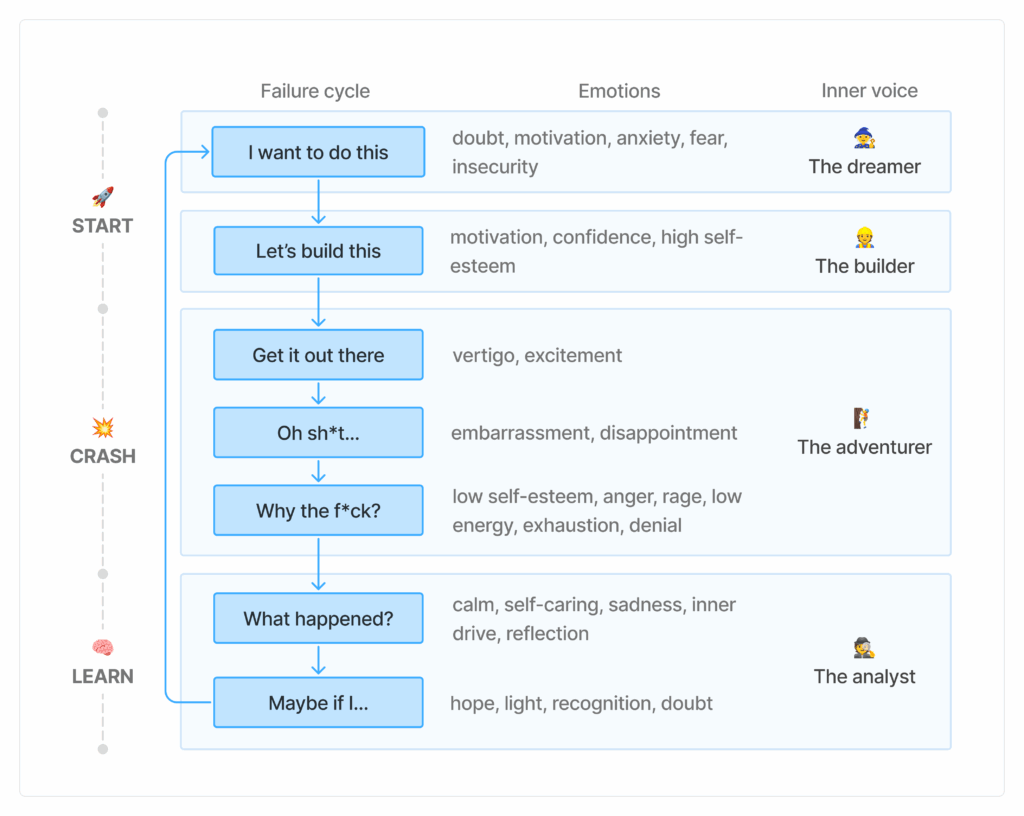
The Start, Crash, Learn, Repeat loop.
Looking at the process, the first thing I felt was confidence.
I once attended a very insightful workshop by Lucy Cullen about burnout. She said something that struck me: plan for the worst case scenario, because then you know how things can develop and what you'd do in that case. Plans give us confidence. Knowing what can come next clears up the uncertainty of not knowing what to expect.
When I look at this chart, I know that I can now try, fail, and — sure — get disappointed and angry again but what comes next is lighter and positive. I'm jumping from a plane but this time I know how landing feels.
Unexpected References
I had read about failing so many times, and had experienced it so many more. However, this time things were much clearer and I was even able to draw this out and write about it.
In fact, I came back to the many books I read and tried to find references to failing. To my surprise, most of them talk about it in much depth, but I guess I was more focused on learning the theory than experiencing the practice when I first read them.
These are the books I've read that mention the process I've been through, I and thought sharing it with you:
"Winners are not afraid of losing. But losers are. Failure is part of the process of success."
Rich Dad Poor Dad
"People who avoid failure also avoid success."
Rich Dad’s Cashflow Quadrant
"Before success comes in any man’s life, he is sure to meet with much temporary defeat, and, perhaps, some failure."
Think and Grow Rich
"Failure is the way forward. If you’re not failing, you’re not improving."
The Subtle Art of Not Giving a F*ck
"Even failed goals can result in substantial advancements."
Measure What Matters
"Failure to achieve your OKRs is a positive indicator."
Radical Focus
"Failure is an option here. If things are not failing, you are not innovating enough."
Elon Musk Biography
"Experiments are supposed to fail."
Million Dollar Weekend
"Every ship pilot is good when the waters are calm, but it is the storm that both tests and improves his skills."
A Handbook for New Stoics
"[Rejection] just meant the offer wasn’t good enough… yet."
$100M Offers
"Failure is the price we pay for standards and the attempt to do better.”
12 Rules for Life
Why I Don't Write About Success Too
I still hate failing, but I'm on my way to accepting that mastering the process of failing leads to find the things that work (also known as "Success").
Success has intentionally been left out of this post. I'll outline the reasons here:
- Success is nice — Embracing a good feeling comes naturally. The challenge is to go against our immediate response mechanisms and learn to embrace what makes us feel bad.
- Success can be seen as failure — Go through the diagram and think of a big crash: someone hoping to get $1m in sales only to achieve $0. Now, go again, and imagine the same person amassing $999,000.00 instead of the expected $1m. That was close! Success or failure? I challenge you to consider the latest and see what happens with your own eyes. Failure is follow up with "postmortem" analysis, while success is simply celebrated.
- I won't treat the word "failure" as taboo anymore — I used to avoid saying the word "failure" out loud, and instead replaced it by "learning". Not anymore. The problem with tabooing words is that we become partially blind on purpose. Failing is a great thing! Someone that fails, especially repeatedly, is brave and must be socially recognized. Fear to failure leads to paralysis. In fact, I believe that paralysis by analysis is just a form of fear of failure.
We must embrace the process of systemically failing. Have a crystal clear understanding of what failure feels like. Imagine going through this process all the time (where failing meets learning and restarting) — eventually, you'd learn to find the wins, and you'd have the skills to virtually solve any problem.
Why I Added "Repeat" to the Chart
Technically speaking, it isn't necessary. However, movement is the key here. Flowing through the different stages in the process constantly and learning to maximize time in the most productive ones and reducing the time in the less productive.
Final Thoughts
Regardless the method you use in your ventures, the key to really master them is to learn to use your emotions in your favor. Learning only happens after the experiment. And most experiments fail.
Hoping that this article sheds some light in your life, I invite you to comment any thoughts or experiences you have had down below. Even more, if you had a similar situation before (chances are you surely have), let's grab a coffee (at least virtually) and chat. I want to learn from your experience.
Thanks for reading.